
Puketāpapa te Maunga
Ōruarangi te Awa
Tainui te Waka
Makaurau te Marae
Te Waiohua me Waikato-Tainui ngā Iwi
Te Ahiwaru te Hapū
Ko Jan-Marie Pinikera Dephoff tōku ingoa
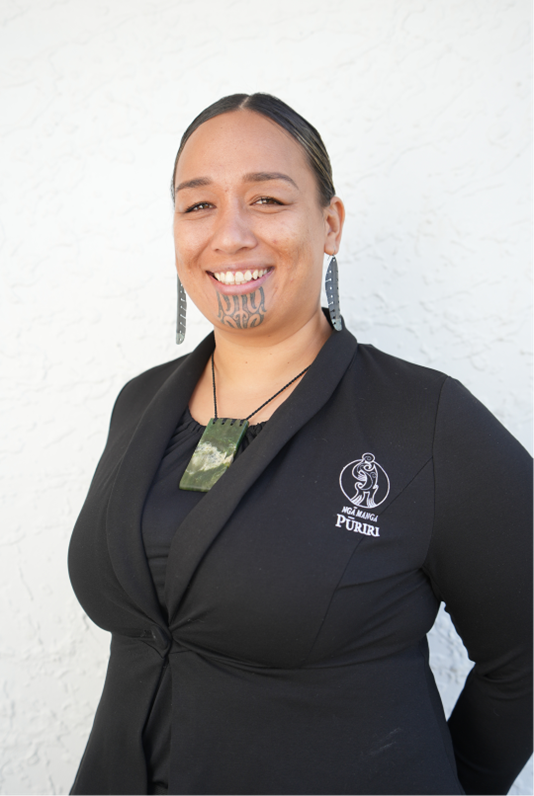
Many social workers bring lived experience into their practice. For Jan-Marie Dephoff, her journey into social work was life changing.
Jan, a clinical practitioner of Waikato-Tainui descent working in mental health and addictions with Ngā Mānga Pūriri, describes her pathway into social work as beginning in “a really messy stage” of her life. She was in a women’s refuge, trying to get help for addiction and leaving an abusive relationship.
At that time, a social worker saw something in her that she could not yet see in herself. Jan remembers them saying, “this doesn’t have to be your life… there’s so much greater things that you can aspire to. You have so much potential.” Those words inspired her to become a social worker. “Everybody has potential,” she says. “I love uncovering the gold. Because everybody has that gold… sometimes people don’t even know that they hold gold.”
Overcoming barriers to qualification
Jan completed her social work degree against the odds. As a solo mother of four young children, she says one of the biggest challenges was “the time commitment… juggling that with my whānau”. Field education placements added more pressure, “It was a huge hurdle… just having to rely on whānau… I needed to humble myself and take the support.”
Despite these barriers, Jan persisted and reached graduation, tears welled in her eyes as she described the experience, “even now this is very emotional. The whole four years I didn’t think I was actually going to get there… it just felt like there was so much against me. It just felt like it was barely even a dream… I’m the first through all my generations… to graduate. And funny thing is, on that graduation day, once I went home, I thought of the social workers at that time and how much I really appreciated them. And I wanted to reach out to them. They never witnessed what my new horizons were and I think it’s a great reminder that even when our journeys with whānau end, our impact still continues.”
From lived experience to professional strength
When Jan first began practising, she worried her lived experience would bring judgement and might even affect her registration. Over time, that changed. “My lived experience is an asset,” she says.
Jan recognises the additional pressures that lived experience brings to her work, balancing her lived experience in practice through reflective self-care, regular clinical and cultural supervision, and a supportive team environment. She uses ongoing reflection to recognise and manage emotions, behaviours, and biases, and relies on workplace support to occasionally step back from client work when necessary to maintain her wellbeing.
Her practice is grounded in the belief that “everybody has potential” and that social workers have the privilege of helping people uncover strengths they may not yet recognise in themselves. “Someone uncovered the gold in you… and you’re now supporting others to uncover the gold.”
A kaupapa Māori framework of practice
Jan frames her practice through a relational, strengths-based approach, grounded in kaupapa Māori values. She describes the powerful metaphor of a waka and outrigger. “The waka is the whānau… they bring all their strengths… and the outrigger… that’s me the social worker.” Within this framework, the social worker does not lead; they support stability and connection binding the waka and the outrigger through whanaungatanga, manaakitanga and kotahitunga. Ultimately the aim is for whānau to venture into new horizons independently and when the waka is stable to unbind the outrigger.. “Once whānau… are ready to do this journey without me… you just unbind it all.” The waka then becomes an independent Waka Kōpapa or even a powerful Waka Taua.
Conclusion
Asked what advice she would give new social work graduates, Jan is clear: “We don’t come into this practice knowing everything… our learning is just going to keep evolving.” She says new graduates should not put unnecessary pressure on themselves to have every answer. “We only have the basics. And now we start building… Allow yourself to keep learning.”elf to keep learning.”
Andrew Thompson, Senior Professional Advisor Social Work
