He pitopito kōrero | News Bulletin
Celebrating World Social Work Day
Today we celebrate World Social Work Day. This year’s theme, ‘Co-Building Hope and Harmony’, highlights the vital role of social work in bringing people together across communities, cultures, and systems to shape a more inclusive and sustainable tomorrow.
It is a day that emphasises the role of social workers in rebuilding trust, strengthening social cohesion, and bringing people together across different cultures and systems to create a more inclusive future. Te aroha ki te tangata we acknowledge your care, respect and kindness towards others and ourselves. Mauri tū, mauri ora.
Celebrating all international and indigenous social work professionals, we are featuring five of our kaimahi. Four are social workers and one is our Registrar, and together they lead and support our kaupapa.

Bottom row: Natasha Emery (social worker), Scott McLew (Registrar)
Based all around New Zealand, the featured five kōrero with us about where they come from, their professional backgrounds and backyards, the impacts of their roles and how we need more connectors and agents of change in our sector.
The social work world is big – and we know we are only one contributor. Through our work we hope to make a positive contribution, enhancing the professionalism of social workers, and building connections to grow a sustainable workforce – together.
Annual Social Work Education Report 2024 published
We are pleased to release the Annual Social Work Education Report 2024, which highlights key trends across the 18 providers delivering prescribed social work qualifications.
Download the Annual Social Work Education Report 2024
Some key points within the report include:
- Ākonga demographics remain consistent with the workforce, with strong Māori and Pacific representation and a predominantly female cohort.
- Completion rates remain a concern, with up to 50% of ākonga not completing their qualification.
- One quarter of enrolled ākonga are aged 40+.
- Part‑time study continues to be common.
- Ākonga in rural areas face additional challenges, including limited access to field placements and increased travel costs.
- In 2024, 74% of graduates registered with the Social Workers Registration Board, leaving one quarter who did not enter the social worker workforce.
- Enrolments declined by a further 4%, reaching their lowest level since 2013.
- Educator workforce sustainability continues to be a challenge, particularly in recruitment and retention.
At the time of writing the report, early indications were that the revised Education Standards are likely to generate change to programme delivery amongst some tertiary education organisations.
While there has also been some discussion within the education sector on the longer-term impacts, there is recognition of the importance of the education pathway for the profession.
This allows the SWRB to anticipate an increase in student numbers and graduates, more TEOs moving from four to three-year degrees, and some additional engagement with TEOs around their reception of change.
These insights will help to inform Sustainable Social Work Pathways – Tauwhiro Ararau, the first national workforce strategy for social work.
Continuing professional development – A critical reflection
Nā Emily Ranginui, Kākaho Arataki Niho Taniwha Māori | Senior Professional Social Work Advisor Māori
Did you know that in 2023 the Board removed the compulsory requirement to provide a critical reflection from each continuing professional development (CPD) activity? This has made recording your CPD so much easier. Now it’s your choice if you want to write a critical reflection.
Almost everyone (87 percent!) who participated in the last CPD audit said logging CPD was easier than it used to be.
I thought it would be good to share some of the comments from participants of the recent audits:
- ‘Initially I thought Oh no! But once I started it was very straight forward as I had logged 80% of my PD.’
- ‘It was ridiculously easy and genuinely not the slightest bit stressful, so thanks for making it such a simple and seamless process!’
- ‘I thought the process was easy to follow and I felt proud of what I had achieved over that time. Very fortunate to work for a very supportive organisation towards staff PD.’
- ‘Thank you for providing a straightforward CPD logging process. I have been holding off doing my logs because of the previous requirement to write-up the reflections which use to be onerous especially when multiple competencies were involved. Now that I can see it’s just a matter of recording the PD I’ve attended, it’s a lot easier to lodge, and easy to access if I need to print off a copy for my next work performance appraisal. Thanks for this.’
Why not try it out and experience how easy it is to upload your CPD.
New online module: Social media and professional boundaries
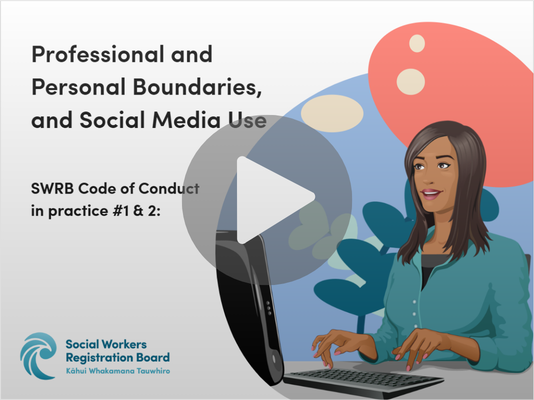
We have developed a new interactive online learning guide for two of our Code of Conduct in practice resources. This module covers social media and personal beliefs and maintaining personal and professional boundaries.
In this module, you can work through real-life situations where a social worker is confronted with issues around personal and professional boundaries. You will be able to explore case studies dealing with the appropriate use of social media as a social worker.
We invite you to explore this module, use it in your supervision sessions and pass it on to other social workers in your network. Don’t forget to log it for your CPD!
Ngā tūranga mahi | Job openings
Chief Advisor, Social Work
This is an influential opportunity for a senior social work leader to shape how Aotearoa regulates and plans for its social work workforce — from the inside, as the Social Workers Registration Board’s senior professional voice. You’ll bring practice wisdom, regulatory credibility, and thought leadership to strengthen how we regulate and plan.
Read more about the Chief Advisor, Social Work role
Board and Tribunal vacancies
The Minister for Social Development and Employment is seeking applications for three roles. This process is managed by the Ministry of Social Development on behalf of the Minister, under the Social Workers Registration Act 2003.
To be considered for any of these roles please apply to the Minister for Social Development by providing a cover letter and a current curriculum vitae. Applications must be made via email to appointments@msd.govt.nz.
Applications are due by 5.00pm on Tuesday 31 March 2026. As part of your application, please let the Minister for Social Development know where you saw the role advertised.
SWRB Board: Layperson member
Application for a layperson member of the Social Workers Registration Board.
The appointee must not be a registered social worker or a member of the Social Workers Disciplinary Tribunal.
Candidates are sought with demonstrated senior management or executive level experience — that includes time spent in a non-government organisation — and an understanding of public sector governance.
Download the position description
Social Workers Disciplinary Tribunal: Social worker and layperson members
Applications and appointees to the Tribunal cannot be members on the Board of the Social Workers Registration Board.
Social worker member: Applications are invited for the appointment of one social worker member. For this position, applicants must be registered social workers who can bring the view of a ‘reasonable and experienced registered social worker’ to Tribunal discussions and can provide input into the decisions that are drafted by the Chair or Deputy Chair.
Layperson member: Applications are invited for the appointment of one layperson member (not a registered social worker). Applicants must be able to represent the public and bring a balanced perspective to the Tribunal’s deliberations and be of proven integrity and good standing within their community.
Download the position descriptions
Te karere a te Tumu Herenga Waka | Message from our Chief Executive
Tēnā tatou katoa, e te iwi.
Nau mai hoki mai Te Ngahuru o Poutūterangi welcome to the tenth month star of Matariki the Māori year which is equivalent to the month of March and appears visible in the night sky around autumn.
I am reflecting on the swift passage of summer and how quickly those months flew by! I would also like to recognise all those contributing to the significant mahi required in these challenging times. Kia kaha tonu.
Today, 17 March 2026, marks World Social Work Day. This international and indigenous day invites us to pause, reflect, and re‑centre ourselves in the purpose of our mahi – to uplift all people, strengthen the wellbeing of hapori, and advancing social work with unity, courage, and purpose.
The significance of the moment is to also recognise the dedication and heart all our Aotearoa sector’s kaimahi bring to their mahi every day, every week, every month, every year. Your care, professionalism, and commitment make a meaningful difference for our whānau and hapori, we are deeply grateful for all that you do.
I am very proud to highlight five kāhui whetū – social work leaders and achievers from across our organisation – in this edition of Onboard, all very different people yet each contributing to aur shared purpose. I look forward to introducing more of our staff in future pānui.
Today we are also releasing two reports that strengthen our research and evidence base: the Social Worker Workforce Insights Report and the Annual Social Work Education Report, both of which you can read on our website.
Feedback from the sector tells us these reports continue to be valued, valuable and informative being shared through many networks.
Heio anō, in the coming months, we will share updates on the development of the social worker workforce strategy and action plan. We thank everyone who has contributed their feedback and advice so far and encourage you to stay engaged and continue sharing your insights as this work progresses.
Ngā manaakitanga
Sarah Clark
