

Summary of feedback and submissions for the Social Worker Strategy and Action Plan
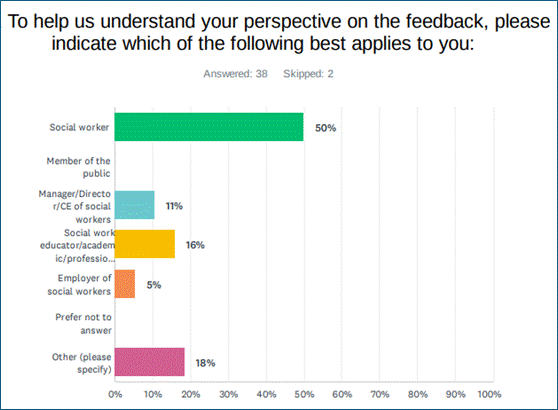
Who we heard from
We received 40 responses via an online feedback form.

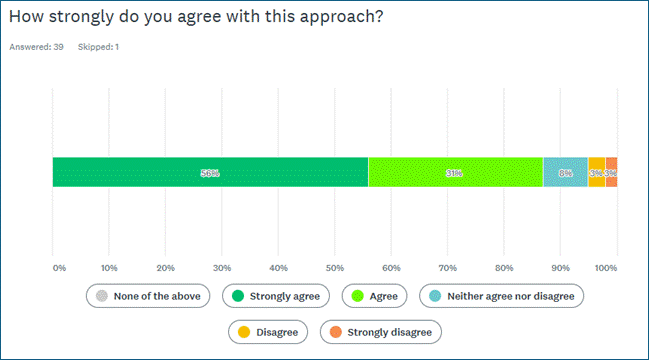
The approach of the Sustainable Social Work Workforce Strategy & Action Plan
56% of the responders said they agreed with the approach of the Workforce Strategy and Action Plan.

Direct quotes of key points we heard in the online feedback form
- “Pay parity for all social workers, including social work educators, is another essential way to maintain the workforce.”
- “There is a shortage of highly skilled supervisors in the social work sector.”
- “Cultural and lived experience, mātauranga Māori, and reo fluency should be formally recognised as legitimate and vital social work expertise — not seen as secondary to Western models.”
- “The collaborative approach could lead to more effective and sustainable solutions which may benefit the social workers and community.”
What we heard through the online feedback form
The feedback can be broadly grouped into 8 themes.
They are:
1. Collaboration and Partnership
- Many respondents strongly support a collaborative approach, emphasising the need for the Social Workers Registration Board (SWRB) and sector to work together, not in silos.
- “We have to take ownership as a profession and the more SWRB can work WITH the sector instead of FOR the sector, the better, in my opinion.”
- “A collaborative approach brings together all perspectives, challenges and learnings to allow a more informed approach to what is required in each space and to form an insightful overall plan of action.”
2. Māori Workforce and Te Tiriti o Waitangi
- There is a clear call for the strategy to explicitly address the needs of Māori, both as service users and as social workers, and to embed Te Tiriti o Waitangi principles.
- “…no mention specifically from the need of Māori (as mentioned 60% of those that access social services identify as Māori AND 25% of Social Workers identify as Māori)… invest in attracting, recruitment and the retention of Māori into the workforce…”
- “The strategy must: Embed kaupapa Māori frameworks and acknowledge mana motuhake of iwi Māori providers and practitioners.”
3. Workforce Lifecycle and Retention
- Respondents value the workforce lifecycle approach but stress the need for practical support at all stages, including re-entry after career breaks and ongoing professional development.
- “Is leaving the profession an absolute or can it be more fluid with options to reenter at an appropriate life stage…?”
- “Supervision occurs across all areas of the workforce lifecycle. Regular professional supervision can help reduce burnout, increase resilience/retention…”
4. Education, Training, and Entry Pathways
- Concerns were raised about the adequacy of current education programmes, the need for more practical placements, and recognition of prior experience.
- “Current social work education programmes do not fully reflect the diversity of the population or the breadth of practice needs.”
- “I have had much experience in NGOs yet I couldn’t cross credit that experience towards my first placement paper.”
5. Financial Barriers and Pay Equity
- Financial challenges are a recurring theme, including the cost of study, registration fees, and pay equity—especially for NGOs and educators.
- “Financial barriers in training are significant for SW students and likely prevent equity and diversity in the profession.”
- “My biggest worry as a current manager for a NGO is that we got finally got pay parity but now the funding has been put into baseline funding with the contracts… NGO’s will struggle to find that funding…”
6. Burnout, Workload, and Wellbeing
- High caseloads, burnout, and lack of support are major concerns, with calls for better management, supervision, and wellbeing initiatives.
- “Experienced Social Workers are hugely valuable but due to high caseloads we are at significant risk of burnout and therefore will consider leaving the profession for less stressful work options even taking lower salaries.”
- “Employers often offer support verbally but then overload us with cases and do not let us practice selfcare.”
7. Professional Recognition and Regulation
- Some respondents feel the profession is undervalued, and that regulatory costs are high relative to perceived benefits.
- “NGO’s largely dependent on Government funded contracts/program delivery currently have little to offer to attract/retain social workers, increasingly under pressure to remove ‘social work /social worker’ from job descriptions/role titles to mitigate costs of registration/practice certification.”
8. Diversity of Views and Inclusion
- There is a desire for the profession to be open to a diversity of political and professional views, and for professional bodies to facilitate open debate.
- “I agree with working together, although I have significant concern about the process and the neoliberal state having more control over the profession. Whose voices will be most prioritised? Social work is a values-based profession, and the hierarchy of values and ethical considerations for social work are very different from many employers and the state.”
- “I think an integrated approach is a good idea as long as it’s not dominated by the large employers.”
- “I want a collaborative approach as a social work network rather than working in silos.”